Lavis Lab
In particular, we are interested in developing probes where the chemical and photophysical properties can be masked by assorted molecular functionalities and then unmasked by a user-designated process involving light, enzymatic activity, or other environmental changes. This chemical masking suppresses unwanted fluorescence signals, thereby functioning as a filter for bioimaging and other experiments. Combining this strategy with advances in instrumentation, protein engineering, and genetic techniques allows us to devise sophisticated ways to illuminate biological systems.
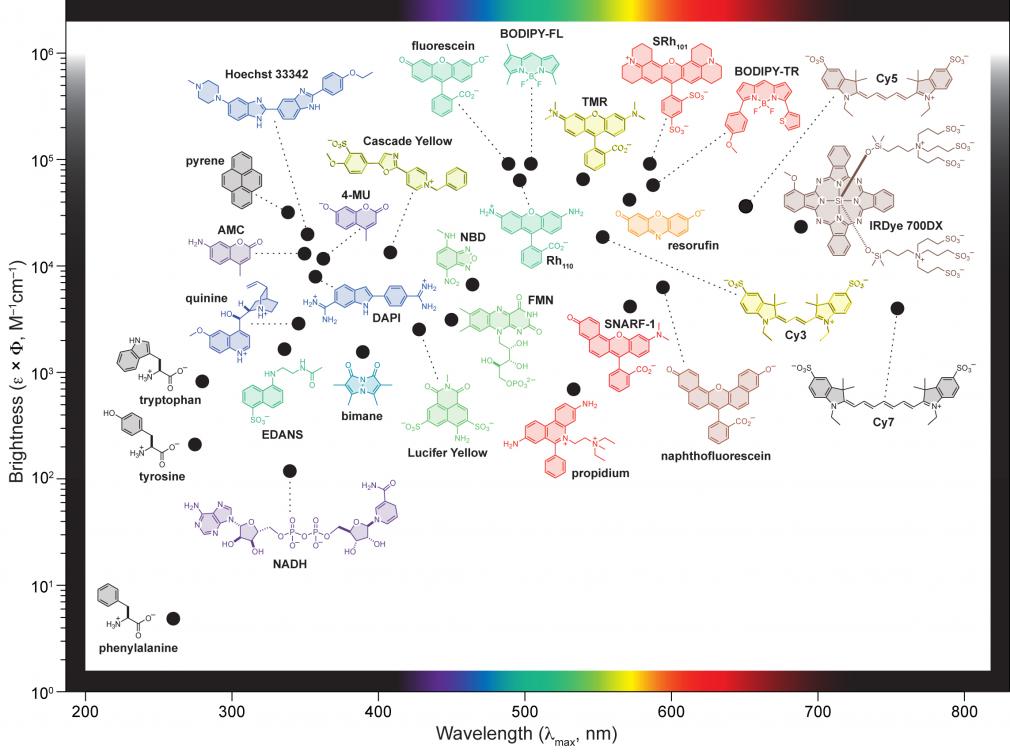
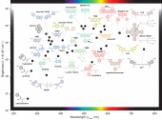
Small organic molecules constitute an important subclass of utilized fluorophores, and countless small-molecule probes are available either commercially or through de novo design and synthesis. This plethora of probes bears an inherent modularity—attachment of different reactive groups, substrate moieties, chelating components, and other chemical functionalities to a somewhat diminutive set of dye scaffolds gives rise to the extant collection of fluorescent probes. A panel of 30 common fluorescent dyes spanning the ultraviolet, visible, and near-infrared spectra regions can be seen in in the above image. The compounds are plotted according to their brightness (extinction coefficient quantum yield) versus absorption maximum and the structures are colored according to their emission maximum.
Our laboratory focuses on the design and synthesis of new fluorescent probes by “tailoring” these foundational fluorescent molecules using organic chemistry. In particular, we are interested in developing probes where the chemical and photophysical properties can be masked by assorted molecular functionalities and then unmasked by a user-designated process involving light, enzymatic activity, or other environmental changes. This chemical masking can suppress unwanted fluorescence signals in various applications, thereby functioning as a filter for bioimaging and other experiments. By combining this strategy with advances in instrumentation, protein engineering, and genetic techniques, we can devise sophisticated ways to illuminate biological systems
Projects (3)
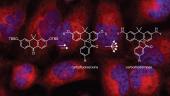
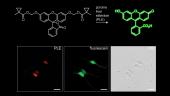
Light can provide exquisite spatiotemporal control over chemical structure. Photochemical activation of small-molecule agonists, fluorescent dyes, and fluorescent proteins can be used in sophisticated experiments to deliver biologically active molecules or facilitate advanced imaging experiments. Photoactivatable “caged” small-molecule fluorophores have certain advantages over photoactivatable fluorescent proteins including smaller size, faster diffusion times, and higher brightness. Despite these advantages, the utility of caged small molecules has languished due to the difficult organic chemistry required to synthesize these compounds. We have developed efficient, general syntheses of highly soluble caged rhodamine and fluorescein dyes to supplement or supplant the proteinous caged probes. We collaborate with Josh Dudman to develop caged fluorophores for neural tracing experiments.
Another exciting application of caged fluorophores is photoactivated localization microscopy (PALM), developed by Eric Betzig and Harald Hess. This technique involves iterative activation and measurement of caged fluorophores within a sample, allowing construction of an ultrahigh-resolution image. Our caged fluorophores have proven excellent labels for PALM. In collaboration with David Clayton we are using our novel dyes to perform advanced super resolution imaging of mitochondria components.
In addition to light, enzymatic activity can be used to manage fluorophore properties. One manifestation of this strategy invokes endogenous enzymes to facilitate the delivery of fluorescent molecules to a biological system. Here, polar moieties in the dye are cloaked as simple esters to allow efficient passage of the molecule through lipid bilayers. Once inside the cell, nonspecific esterases make the fluorescent molecule. This method can be used to deliver simple fluorophores or fluorescent ion indicators to live cells in vitro or in vivo.
The number and specificity of esterases responsible for unmasking ester groups inside cells is unknown. This information is critical to developing better strategies for delivering small molecules to cells and specific subcellular locales. To better understand the activity of cellular esterases, we have synthesized libraries of highly stable fluorogenic esterase substrates bearing diverse ester functionalities. Screening of these libraries against different cell types and tissues has revealed novel ester groups that are cleaved efficiently by native cellular esterases and we work with Karel Svoboda and Josh Dudman to use these ester functionalities to improve delivery of fluorescent ion indicators to the brain.
In addition to using native enzymes, we also use fluorogenic compounds to discover and evaluate orthogonal enzyme–substrate pairs. Expression of exogenous enzymes inside cells is a powerful method for targeting small molecules to cells. Fluorogenic enzyme substrates allow rapid assessment of exogenous enzyme activity. These enzyme–substrate systems can be used in different model organisms. Gerry Rubin and Michael Reiser use our fluorogenic substrates to facilitate light microscopy-based neuronal tracing experiments in Drosophila. In addition, we work with Loren Looger and Scott Sternson to find enzyme–substrate pairs that allow pharmacological agents to be targeted to genetically defined cellular populations in mammalian tissues.
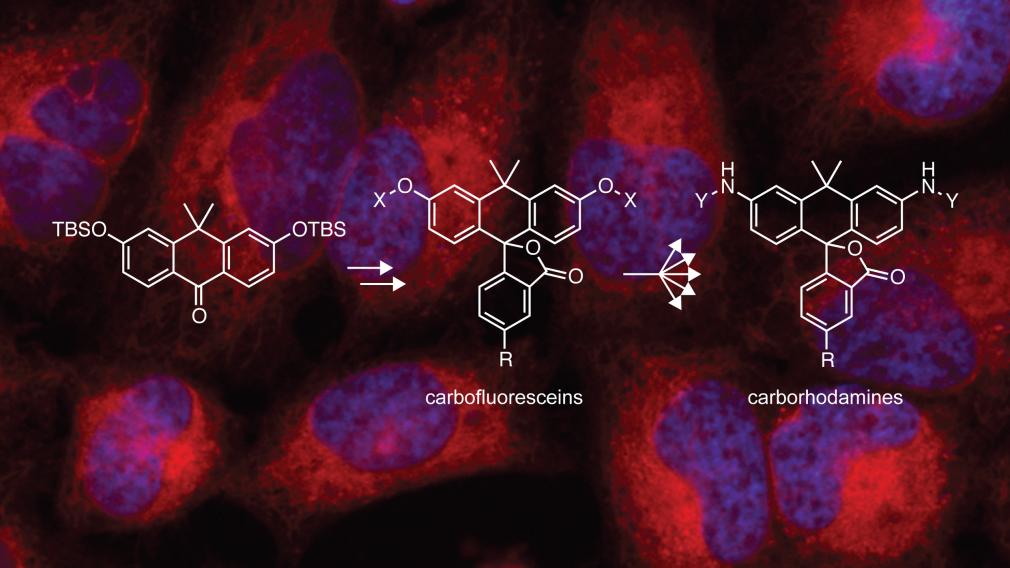
As toolmakers, the overall goal of our research is developing novel molecules to advance bioresearch. Commensurate with this objective is the development of novel paths toward the synthesis of fluorescent dyes and their derivatives. Rather than remain complacent about the current portfolio of chemical transformations used in dye research—some reactions date back to the 19th century—we explore new synthesis techniques and apply them to the creation of novel dye derivatives. The broad projects described above take advantage of the fact that small-molecule fluorophores can be tuned to a specific function using synthetic organic chemistry. We have developed new divergent synthetic methodologies that allow the efficient construction of fluorescent dyes. This has allowed the rapid construction of large numbers of novel compounds, and together with Tim Harris and APIG, we evaluate the photophysical and chemical properties of these dyes in search of better probes for fluorecensce miscroscopy.
The opportunity to interact closely with physicists, engineers, and biologists at Janelia Farm Research Campus provides a fertile place for applying organic chemistry to biological problems. The unique power of the chemical discipline is the capacity to construct molecules of definite structure. As chemists at Janelia, we ply our craft in concert with scientists from other disciplines to shed light on complex problems in neurobiology and beyond.
-
Luke Lavis Lab Head
-
Sambashiva Banala Postdoctoral Associate
-
Adam Berro Research Staff
-
Jonathan Grimm Research Staff
-
Todd Gruber Research Staff
-
Charles Kim Senior Scientist
-
James Martin
Janelia Publications
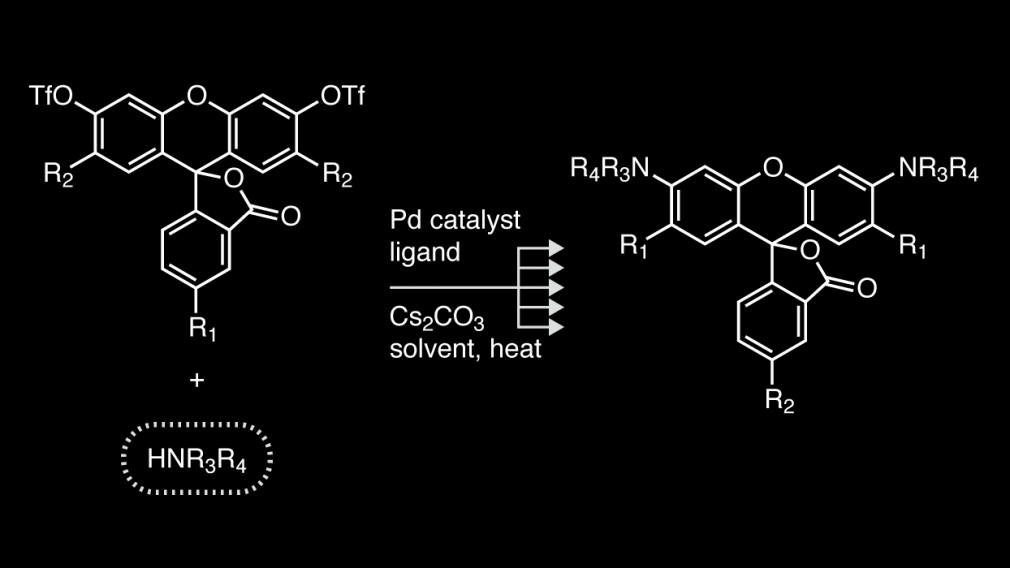
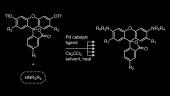
A unified, convenient, and efficient strategy for the preparation of rhodamines and N,N'-diacylated rhodamines has been developed. Fluorescein ditriflates were found to undergo palladium-catalyzed C-N cross-coupling with amines, amides, carbamates, and other nitrogen nucleophiles to provide direct access to known and novel rhodamine derivatives, including fluorescent dyes, quenchers, and latent fluorophores.
Phenolic fluorophores such as fluorescein, Tokyo Green, resorufin, and their derivatives are workhorses of biological science. Acylating the phenolic hydroxyl group(s) in these fluorophores masks their fluorescence. The ensuing ester is a substrate for cellular esterases, which can restore fluorescence. These esters are, however, notoriously unstable to hydrolysis, severely compromising their utility. The acetoxymethyl (AM) group is an esterase-sensitive motif that can mask polar functionalities in small molecules. Here, we report on the use of AM ether groups to mask phenolic fluorophores. The resulting profluorophores have a desirable combination of low background fluorescence, high chemical stability, and high enzymatic reactivity, both in vitro and in cellulo. These simple phenyl ether-based profluorophores could supplement or supplant the use of phenyl esters for imaging biochemical and biological systems.
Histochemistry (chemistry in the context of biological tissue) is an invaluable set of techniques used to visualize biological structures. This field lies at the interface of organic chemistry, biochemistry, and biology. Integration of these disciplines over the past century has permitted the imaging of cells and tissues using microscopy. Today, by exploiting the unique chemical environments within cells, heterologous expression techniques, and enzymatic activity, histochemical methods can be used to visualize structures in living matter. This review focuses on the labeling techniques and organic fluorophores used in live cells.
Small molecule fluorophores are essential tools for chemical biology. A benefit of synthetic dyes is the ability to employ chemical approaches to control the properties and direct the position of the fluorophore. Applying modern synthetic organic chemistry strategies enables efficient tailoring of the chemical structure to obtain probes for specific biological experiments. Chemistry can also be used to activate fluorophores; new fluorogenic enzyme substrates and photoactivatable compounds with improved properties have been prepared that facilitate advanced imaging experiments with low background fluorescence. Finally, chemical reactions in live cells can be used to direct the spatial distribution of the fluorophore, allowing labeling of defined cellular regions with synthetic dyes.
A recent study challenges the oft-held notion that ester bonds in prodrug molecules are cleaved rapidly and completely inside cells by endogenous, nonspecific esterases. Structure-activity relationship studies on acylated sugars reveal that regioisomeric compounds display disparate biological activity, suggesting that ester bonds can persist in a cellular context.
Prior Publications (11)
Bovine pancreatic ribonuclease (RNase A) can enter human cells, even though it lacks a cognate cell-surface receptor protein. Here, we report on the biochemical basis for its cellular uptake. Analyses in vitro and in cellulo revealed that RNase A interacts tightly with abundant cell-surface proteoglycans containing glycosaminoglycans, such as heparan sulfate and chondroitin sulfate, as well as with sialic acid-containing glycoproteins. The uptake of RNase A correlates with cell anionicity, as quantified by measuring electrophoretic mobility. The cellular binding and uptake of RNase A contrast with those of Onconase, an amphibian homologue that does not interact tightly with anionic cell-surface glycans. As anionic glycans are especially abundant on human tumor cells, our data predicate utility for mammalian ribonucleases as cancer chemotherapeutic agents.
Onconase (ONC) is a member of the ribonuclease A superfamily that is toxic to cancer cells in vitro and in vivo. ONC is now in Phase IIIb clinical trials for the treatment of malignant mesothelioma. Internalization of ONC to the cytosol of cancer cells is essential for its cytotoxic activity, despite the apparent absence of a cell-surface receptor protein. Endocytosis and cytotoxicity do, however, appear to correlate with the net positive charge of ribonucleases. To dissect the contribution made by the endogenous arginine and lysine residues of ONC to its cytotoxicity, 22 variants were created in which cationic residues were replaced with alanine. Variants with the same net charge (+2 to +5) as well as equivalent catalytic activity and conformational stability were found to exhibit large (> 10-fold) differences in toxicity for the cells of a human leukemia line. In addition, a more cationic ONC variant could be either much more or much less cytotoxic than a less cationic variant, again depending on the distribution of its cationic residues. The endocytosis of variants with widely divergent cytotoxic activity was quantified by flow cytometry using a small-molecule fluorogenic label, and was found to vary by twofold or less. This small difference in endocytosis did not account for the large difference in cytotoxicity, implicating the distribution of cationic residues as being critical for lipid-bilayer translocation subsequent to endocytosis. This finding has fundamental implications for understanding the interaction of ribonucleases and other proteins with mammalian cells.
Haloalkane dehalogenase (HD) catalyzes the hydrolysis of haloalkanes via a covalent enzyme-substrate intermediate. Fusing a target protein to an HD variant that cannot hydrolyze the intermediate enables labeling of the target protein with a haloalkane in cellulo. The utility of extant probes is hampered, however, by background fluorescence as well as limited membrane permeability. Here, we report on the synthesis and use of a fluorogenic affinity label that, after unmasking by an intracellular esterase, labels an HD variant in cellulo. Labeling is rapid and specific, as expected from the reliance upon enzymic catalysts and the high membrane permeance of the probe both before and after unmasking. Most notably, even high concentrations of the fluorogenic affinity label cause minimal background fluorescence without a need to wash the cells. We envision that such fluorogenic affinity labels, which enlist catalysis by two cellular enzymes, will find utility in pulse-chase experiments, high-content screening, and numerous other protocols.
Small-molecule fluorescent probes embody an essential facet of chemical biology. Although numerous compounds are known, the ensemble of fluorescent probes is based on a modest collection of modular "core" dyes. The elaboration of these dyes with diverse chemical moieties is enabling the precise interrogation of biochemical and biological systems. The importance of fluorescence-based technologies in chemical biology elicits a necessity to understand the major classes of small-molecule fluorophores. Here, we examine the chemical and photophysical properties of oft-used fluorophores and highlight classic and contemporary examples in which utility has been built upon these scaffolds.
p-Nitrophenyl acetate is the most commonly used substrate for detecting the catalytic activity of esterases, including those that activate prodrugs in human cells. This substrate is unstable in aqueous solution, limiting its utility. Here, a stable chromogenic substrate for esterases is produced by the structural isolation of an acetyl ester and p-nitroaniline group using a trimethyl lock moiety. Upon ester hydrolysis, unfavorable steric interactions between the three methyl groups of this o-hydroxycinnamic acid derivative encourage rapid lactonization to form a hydrocoumarin and release p-nitroaniline. This "prochromophore" could find use in a variety of assays.
A derivative of rhodamine 110 has been designed and assessed as a probe for cytochrome P450 activity. This probe is the first to utilize a 'trimethyl lock' that is triggered by cleavage of an ether bond. In vitro, fluorescence was manifested by the CYP1A1 isozyme with k(cat)/K(M)=8.8x10(3)M(-1)s(-1) and K(M)=0.09microM. In cellulo, the probe revealed the induction of cytochrome P450 activity by the carcinogen 2,3,7,8-tetrachlorodibenzo-p-dioxin, and its repression by the chemoprotectant resveratrol.
The phenolic pKa of fluorescein varies depending on its environment. The fluorescence of the dye varies likewise. Accordingly, a change in fluorescence can report on the association of a fluorescein conjugate to another molecule. Here, we demonstrate how to optimize this process with chemical synthesis. The fluorescence of fluorescein-labeled model protein, bovine pancreatic ribonuclease (RNase A), decreases upon binding to its cognate inhibitor protein (RI). Free and RI-bound fluorescein-RNase A have pKa values of 6.35 and 6.70, respectively, leaving the fluorescein moiety largely unprotonated at physiological pH and thus limiting the sensitivity of the assay. To increase the fluorescein pKa and, hence, the assay sensitivity, we installed an electron-donating alkyl group ortho to each phenol group. 2',7'-Diethylfluorescein (DEF) has spectral properties similar to those of fluorescein but a higher phenolic pKa. Most importantly, free and RI-bound DEF-RNase A have pKa values of 6.68 and 7.29, respectively, resulting in a substantial increase in the sensitivity of the assay. Using DEF-RNase A rather than fluorescein-RNase A in a microplate assay at pH 7.12 increased the Z'-factor from -0.17 to 0.69. We propose that synthetic "tuning" of the pKa of fluorescein and other pH-sensitive fluorophores provides a general means to optimize binding assays.
The evolutionary rate of proteins involved in obligate protein-protein interactions is slower and the degree of coevolution higher than that for nonobligate protein-protein interactions. The coevolution of the proteins involved in certain nonobligate interactions is, however, essential to cell survival. To gain insight into the coevolution of one such nonobligate protein pair, the cytosolic ribonuclease inhibitor (RI) proteins and secretory pancreatic-type ribonucleases from cow (Bos taurus) and human (Homo sapiens) were produced in Escherichia coli and purified, and their physicochemical properties were analyzed. The two intraspecies complexes were found to be extremely tight (bovine Kd = 0.69 fM; human Kd = 0.34 fM). Human RI binds to its cognate ribonuclease (RNase 1) with 100-fold greater affinity than to the bovine homologue (RNase A). In contrast, bovine RI binds to RNase 1 and RNase A with nearly equal affinity. This broader specificity is consistent with there being more pancreatic-type ribonucleases in cows (20) than humans (13). Human RI (32 cysteine residues) also has 4-fold less resistance to oxidation by hydrogen peroxide than does bovine RI (29 cysteine residues). This decreased oxidative stability of human RI, which is caused largely by Cys74, implies a larger role for human RI as an antioxidant. The conformational and oxidative stabilities of both RIs increase upon complex formation with ribonucleases. Thus, RI has evolved to maintain its inhibition of invading ribonucleases, even when confronted with extreme environmental stress. That role appears to take precedence over its role in mediating oxidative damage.
Cells tightly regulate their contents. Still, nonspecific Coulombic interactions between cationic molecules and anionic membrane components can lead to adventitious endocytosis. Here, we characterize this process in a natural system. To do so, we create variants of human pancreatic ribonuclease (RNase 1) that differ in net molecular charge. By conjugating a small-molecule latent fluorophore to these variants and using flow cytometry, we are able to determine the kinetic mechanism for RNase 1 internalization into live human cells. We find that internalization increases with solution concentration and is not saturable. Internalization also increases with time to a steady-state level, which varies linearly with molecular charge. In contrast, the rate constant for internalization (t1/2 = 2 h) is independent of charge. We conclude that internalization involves an extracellular equilibrium complex between the cationic proteins and abundant anionic cell-surface molecules, followed by rate-limiting internalization. The enhanced internalization of more cationic variants of RNase 1 is, however, countered by their increased affinity for the cytosolic ribonuclease inhibitor protein, which is anionic. Thus, Coulombic forces mediate extracellular and intracellular equilibria in a dichotomous manner that both endangers cells and defends them from the potentially lethal enzymatic activity of ribonucleases.
Traditional small-molecule fluorophores are always fluorescent. This attribute can obscure valuable information in biological experiments. Here, we report on a versatile "latent" fluorophore that overcomes this limitation. At the core of the latent fluorophore is a derivative of rhodamine in which one nitrogen is modified as a urea. That modification enables rhodamine to retain half of its fluorescence while facilitating conjugation to a target molecule. The other nitrogen of rhodamine is modified with a "trimethyl lock", which enables fluorescence to be unmasked fully by a single user-designated chemical reaction. An esterase-reactive latent fluorophore was synthesized in high yield and attached covalently to a cationic protein. The resulting conjugate was not fluorescent in the absence of esterases. The enzymatic activity of esterases in endocytic vesicles and the cytosol educed fluorescence, enabling the time-lapse imaging of endocytosis into live human cells and thus providing unprecedented spatiotemporal resolution of this process. The modular design of this "fluorogenic label" enables the facile synthesis of an ensemble of small-molecule probes for the illumination of numerous biochemical and cell biological processes.